

If you’re a contractor, you’ve probably gotten an email like this:
“Hey, can you add us to your insurance?”
Seems simple—but this is where a lot of confusion (and mistakes) happen.
There’s a big difference between:
- Listing someone as a Certificate Holder
- Naming someone as an Additional Insured
Understanding this can protect your business from gaps in coverage, contract issues, and unexpected costs.
1. What Is a Certificate Holder?
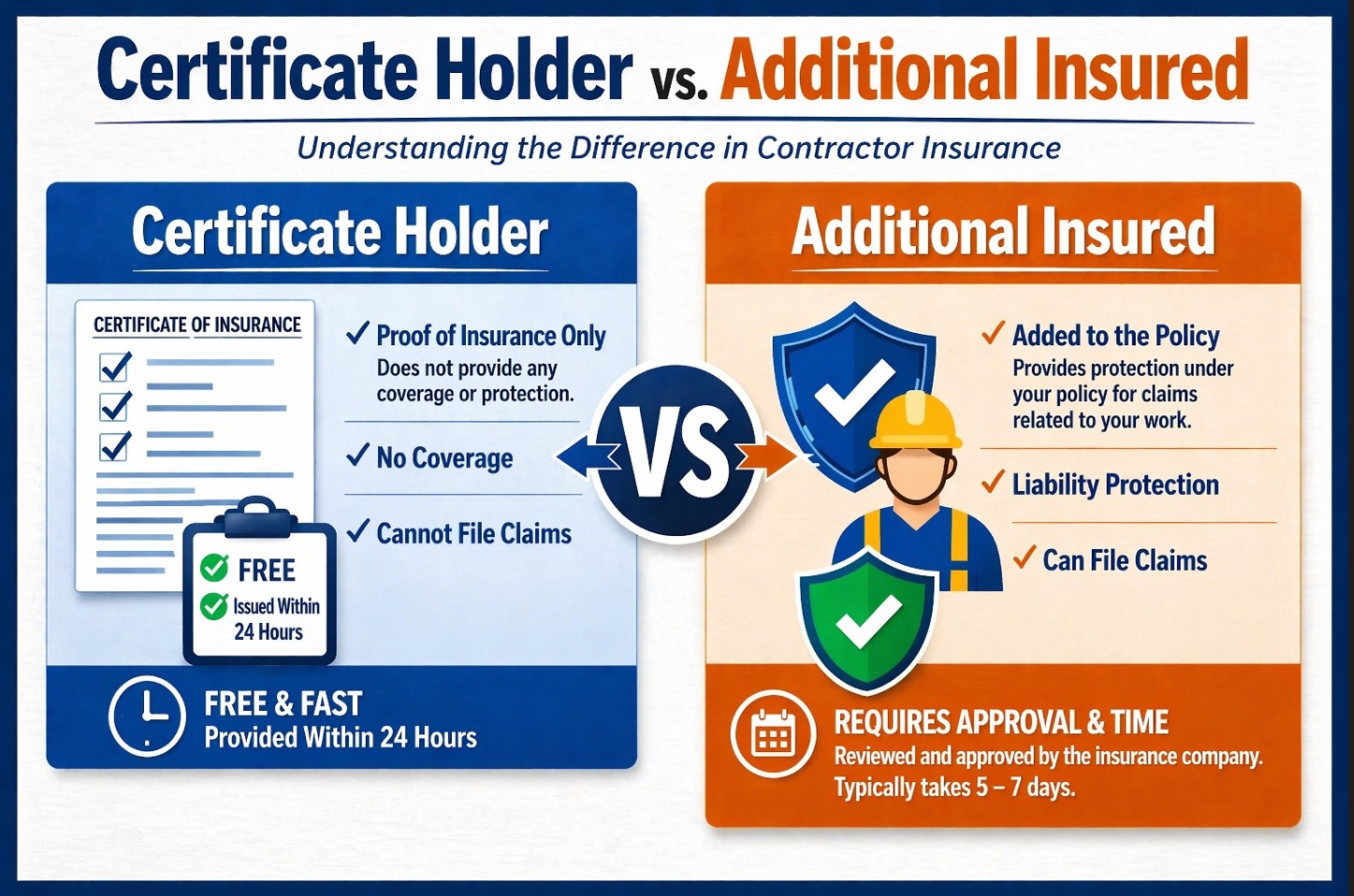
A Certificate Holder is simply someone who receives proof that you have insurance.
They are listed on a Certificate of Insurance (COI), which shows:
- Your coverage types
- Policy limits
- Effective dates
Important:
A Certificate Holder has zero coverage under your policy.
They:
- ❌ Cannot file a claim on your policy
- ❌ Are not protected by your insurance
- ❌ Do not receive legal defense
Think of it like this:
👉 A Certificate Holder is just watching from the sidelines.
2. What Is an Additional Insured?
An Additional Insured (AI) is someone who is actually added to your policy through an endorsement from the insurance company.
This means they do receive protection under your policy—but only for claims related to your work.
What this means:
- ✅ They can seek coverage under your policy
- ✅ They may receive legal defense
- ✅ Your policy helps protect them if you cause a claim
Real-world example:
If you’re a subcontractor working for a general contractor:
- The GC may require you to name them as an Additional Insured
- If a claim arises from your work, your policy can respond on their behalf
👉 This shifts risk to the party performing the work (you)
3. The #1 Misunderstanding
A lot of contractors think:
“If I list them on the certificate, I’m good.”
That’s not true.
A Certificate of Insurance does NOT grant Additional Insured status.
The only way to properly add someone is:
👉 Through an official endorsement issued by your insurance company
4. When Do You Need to Add an Additional Insured?
Usually when a contract requires it.
Common situations:
- A General Contractor requires it from a subcontractor
- A Project Owner requires it from a contractor
- A Property Manager or Landlord requires it
If your contract says “Additional Insured required,” a certificate alone will not satisfy that requirement.
5. Important: Additional Insured Endorsements Often Cost Money
This is something many contractors don’t realize upfront.
👉 Adding an Additional Insured is not always free.
Depending on your policy, you may see:
- Per endorsement fees
- Blanket endorsement costs built into your policy
- Additional charges for completed operations coverage
Quick breakdown:
- Some policies include basic AI endorsements at no cost
- Others charge per request or per project
- More advanced coverage (like completed operations) typically costs extra
👉 Bottom line: Every request to “add someone” can have a real cost
6. Not All Additional Insured Coverage Is the Same
Even when someone is added, coverage is limited.
Most endorsements:
- Only cover the Additional Insured for your work
- Do not cover their sole negligence
- May be limited to:
- Ongoing operations (while work is in progress)
- Completed operations (after the job is finished – often requires an extra endorsement)
👉 This is why contracts and insurance don’t always perfectly match
7. What You Should Do When You Get This Request
When a client emails you asking to be “added to your insurance,” don’t guess.
Do this instead:
- Check the contract requirements
- Send the request to your insurance advisor
- Confirm:
- Do they need Certificate Holder or Additional Insured?
- Are there specific endorsement requirements?
- Is there a cost?
8. Simple Way to Think About It
- Certificate Holder = Proof of insurance only
- Additional Insured = Actually covered under your policy
👉 One is paperwork
👉 The other is protection
Final Thoughts
This is one of the most common (and most misunderstood) parts of contractor insurance.
Getting it wrong can lead to:
- Breach of contract issues
- Denied claims
- Out-of-pocket legal costs
Getting it right helps:
- Protect your business
- Keep contracts compliant
- Avoid surprises
Need Help?
If you’re not sure what’s being requested—or how to handle it—reach out before submitting anything.
📞 Call or Text: 530.320.3617
📧 Email: Kevin@TheContractorsResourceCenter.com