

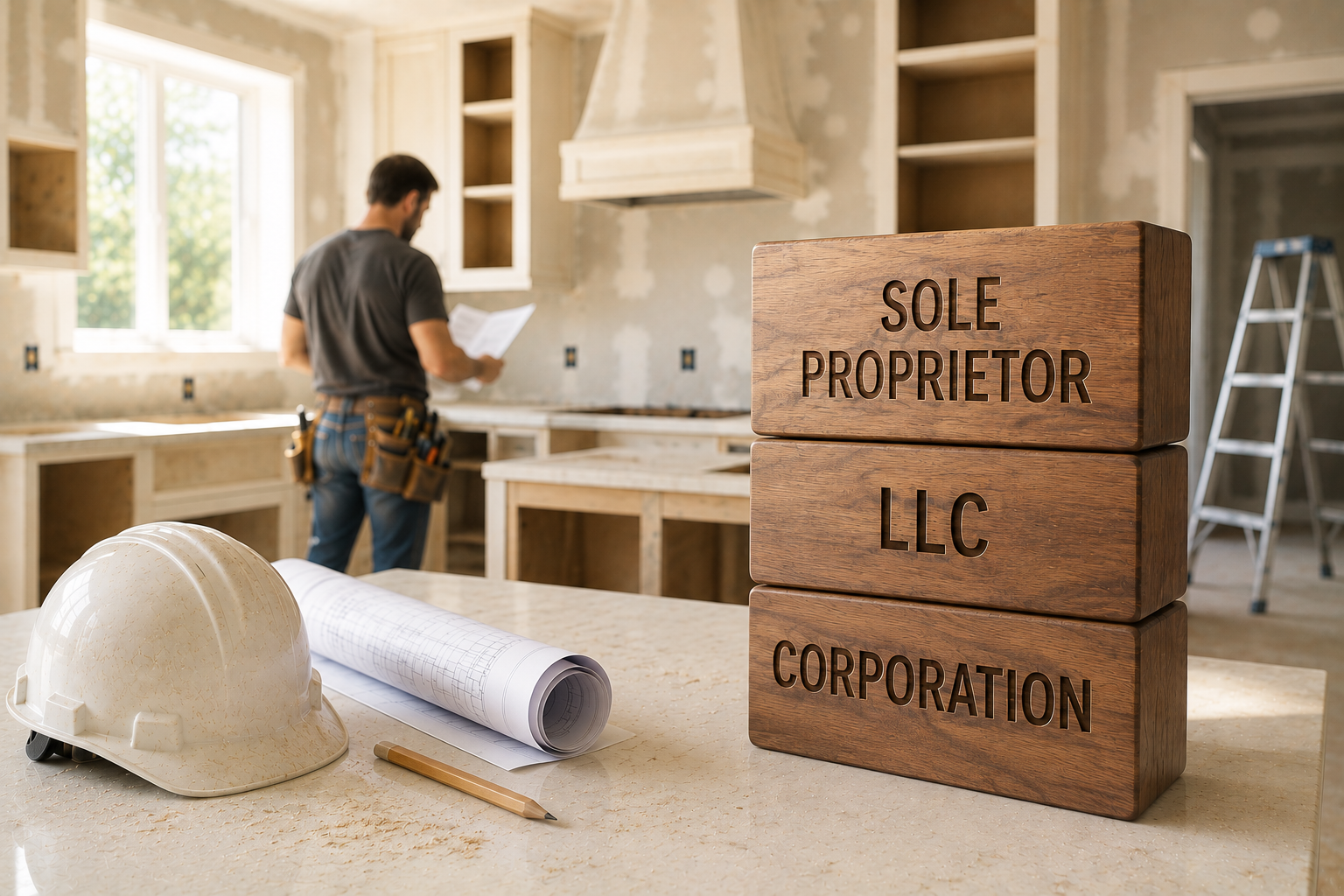
You’re Licensed… Now What?
You’ve finally earned your California contractor license. You’re ready to start bidding jobs when suddenly everyone starts giving you different advice.
“You need an LLC.”
“You should incorporate.”
“Stay a Sole Proprietor.”
“My accountant says…”
So who’s right?
The truth is, there isn’t a one-size-fits-all answer.
Many successful California contractors start as Sole Proprietors and later transition to an LLC or Corporation as their businesses grow. The best choice depends on your goals, your revenue, your risk, and where your business is today.
This guide will help you understand your options so you can have a more informed conversation with your CPA and attorney.
Why Contractors Ask This Question
Most contractors begin thinking about an LLC or Corporation because they want to:
- Protect their personal assets
- Save money on taxes
- Look more professional
- Hire employees
- Grow a larger business
These are all good reasons—but they’re also areas where a lot of misinformation exists.
Let’s simplify the decision.
At a Glance
| Sole Proprietor | LLC | Corporation | |
|---|---|---|---|
| Easy to Start | ✅ | Moderate | Moderate |
| Lowest Cost | ✅ | ❌ | ❌ |
| Separate Legal Entity | ❌ | ✅ | ✅ |
| May Provide Personal Liability Protection* | ❌ | ✅ | ✅ |
| Professional Image | Good | Better | Better |
| Scalable for Growth | Good | Excellent | Excellent |
*Subject to applicable law and properly maintaining the business entity.
First, Let’s Clear Up a Common Misconception
Many contractors use the terms “LLC” and “incorporated” interchangeably—but they are not the same thing.
- LLC (Limited Liability Company) is one type of business entity.
- Corporation is another type of business entity.
- S-Corporation is generally a tax election, not a business entity by itself.
Understanding this distinction can save a lot of confusion when speaking with your CPA or attorney.
Option 1: Sole Proprietorship
A Sole Proprietorship is the simplest and least expensive way to start a contracting business.
Advantages
- Lowest startup costs
- Simple bookkeeping
- Minimal paperwork
- Easy tax reporting
- No California LLC Franchise Tax
Considerations
As a Sole Proprietor, you and your business are legally the same entity. Depending on the circumstances, your personal assets may be exposed to business debts, lawsuits, or other business obligations.
General Liability Insurance is an important part of protecting your business, but it doesn’t eliminate every potential risk.
Example
Mike just received his painting contractor license. He’s working alone from his home, has very little overhead, and wants to keep his startup costs low.
For someone like Mike, beginning as a Sole Proprietor may be a practical and cost-effective choice.
Option 2: Limited Liability Company (LLC)
An LLC creates a separate legal business entity.
Many contractors choose an LLC because it may help protect personal assets from many business-related liabilities while creating a more professional business structure.
It’s important to remember that an LLC is not a substitute for insurance and doesn’t protect against every situation, including personal negligence, fraud, personal guarantees, or failing to properly maintain the business entity.
Advantages
- May provide additional liability protection
- Separate legal business entity
- Increased credibility
- Easier separation of personal and business finances
- Flexible ownership structure
- Can elect S-Corporation taxation if appropriate
Considerations
California LLCs have additional requirements, including:
- Annual California Franchise Tax
- State filings and compliance
- $100,000 LLC Employee/Worker Bond
- General Liability Insurance required by the CSLB
These additional costs should be weighed against the benefits.
Example
Sarah owns a remodeling company with several employees, company vehicles, and growing annual revenue. She’s investing in equipment and taking on larger projects.
At this stage, discussing an LLC with her CPA and attorney may make sense.
Option 3: Corporation
Some contractors eventually operate as a Corporation, often electing S-Corporation tax treatment.
Corporations generally involve additional payroll, bookkeeping, and administrative responsibilities, but they may offer advantages for established, profitable businesses.
Whether this structure is appropriate depends on your specific financial situation and should be discussed with your CPA.
California Contractor Requirements
Every California contractor must maintain a $25,000 Contractor License Bond.
If you operate as an LLC, California also requires:
- A $100,000 LLC Employee/Worker Bond
- General Liability Insurance that meets CSLB requirements
If you change from a Sole Proprietorship to an LLC or Corporation, you’ll generally need to apply for a new CSLB contractor license because the legal business entity has changed.
What About Taxes?
Taxes are one of the biggest reasons contractors consider changing business structures—but they’re also one of the most misunderstood.
Simply forming an LLC does not automatically lower your taxes.
Many single-member LLCs are taxed similarly to Sole Proprietorships unless another tax election is made.
Some profitable contractors later elect S-Corporation taxation, which may reduce self-employment taxes under the right circumstances.
Before making tax-related decisions, consult your CPA.
Should You Consider Changing?
Ask yourself these questions:
- Is my business becoming consistently more profitable?
- Am I hiring employees?
- Am I purchasing expensive equipment?
- Am I taking on larger projects?
- Do I want additional liability protection?
- Has my CPA recommended a different business structure?
If you answered “Yes” to several of these questions, it may be time to discuss your options with your CPA and attorney.
Common Myths
Myth: “An LLC protects me from everything.”
False. An LLC may provide valuable liability protection, but it doesn’t replace insurance or eliminate personal responsibility.
Myth: “An LLC automatically lowers my taxes.”
False. Tax savings generally come from specific tax elections—not simply from forming an LLC.
Myth: “Every contractor should incorporate.”
False. Many successful contractors remain Sole Proprietors because it fits their current business model and goals.
Frequently Asked Questions
Do I need an LLC to get a California contractor license?
No. Many licensed contractors operate as Sole Proprietors.
Can I change from a Sole Proprietor to an LLC later?
Yes. Many contractors begin as Sole Proprietors and transition to an LLC or Corporation as their businesses grow.
Does an LLC replace General Liability Insurance?
No. An LLC and General Liability Insurance serve different purposes, and one does not replace the other.
Will forming an LLC lower my taxes?
Not automatically. Tax savings depend on your specific situation and any tax elections you make with guidance from your CPA.
Final Thoughts
Choosing your business structure is one of the first major decisions you’ll make as a contractor.
The good news is that your decision today doesn’t have to be your decision forever.
Many successful California contractors begin as Sole Proprietors because it’s simple and affordable. As their businesses grow, they transition to an LLC or Corporation when the additional liability protection, credibility, and potential tax planning opportunities justify the added cost and complexity.
Choose the business structure that fits your business today while planning for where you want it to be tomorrow.
Continue Your Contractor Success Journey
- New California Contractor Guide: Licensing, Bonds, Insurance, Ghost Policies & Business Startup Checklist
- California Workers’ Compensation & Ghost Policy Guide for Contractors
- What Every California Contractor Needs to Know Before Getting Licensed
Still Have Questions?
Choosing the right business structure is an important decision, and there’s no one-size-fits-all answer.
While I don’t provide legal or tax advice, I’ve spent more than 20 years helping California contractors navigate licensing, contractor bonds, General Liability Insurance, Workers’ Compensation, Ghost Policies, and many of the business decisions that come with starting and growing a successful construction company.
If you have questions about contractor licensing, insurance, bonding requirements, or how your business structure may affect your insurance needs, I’m always happy to point you in the right direction.
Kevin Leipsic
Founder & President
The Contractors Resource Center
📞 530-320-3617
✉️ Kevin@TheContractorsResourceCenter.com
About the Author
Kevin Leipsic is the Founder & President of The Contractors Resource Center and an Insurance Advisor for the California Building Industry Association (CBIA). His mission is to help California contractors start, grow, and protect successful construction businesses through practical education, trusted resources, and insurance solutions tailored to the construction industry.
Kevin is also the host of ContractorTV, where he interviews industry experts and shares educational content to help contractors make informed business decisions.
Educational Disclaimer
This article is intended for educational purposes only and should not be considered legal, tax, or accounting advice. Every contractor’s situation is unique. Before choosing or changing your business structure, consult with a qualified attorney and CPA.
At The Contractors Resource Center, we help California contractors navigate licensing, contractor bonds, General Liability Insurance, Workers’ Compensation, Ghost Policies, and many of the business decisions that come with starting and growing a successful construction business. While we don’t provide legal or tax advice, our mission is to provide practical education and trusted resources to help contractors make informed decisions.